
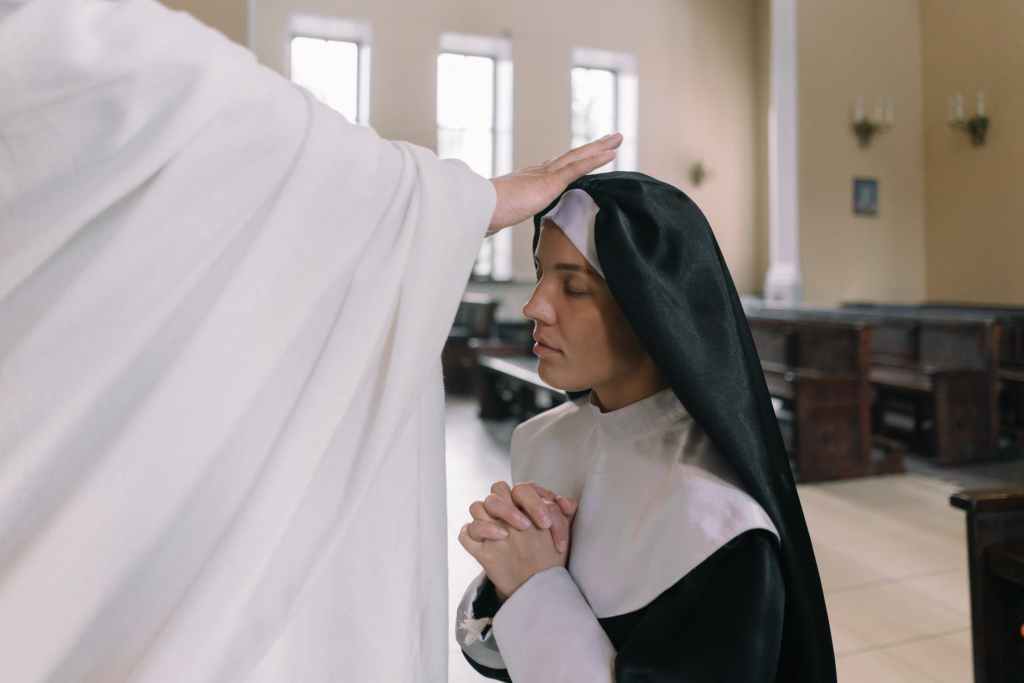
When I was a little girl, I wanted to be a Catholic Nun. (I also wanted to be a lawyer, but never mind that.) Mostly, I think I just wanted to be that good… nun good. Of course, I did not join a convent or become a nun. I wasn’t even very good (certainly not holy), but the fascination with the nun lifestyle never left me. I still like learning about nuns and their religious practices.
I recently re-watched the movie Fatima. Fatima is, perhaps, one of the most popular and widely known stories of a nun named Lucia. The Blessed Virgin Mary is said to have appeared to Lucia and her two cousins in 1917 Portugal when they were children. Lucia went on to join a convent, while her two cousins died shortly after the apparitions. The last convent Lucia lived in was a Carmelite convent, where she most likely lived a cloistered life of contemplative prayer.
Many Carmelites live secluded lives devoting their time to prayer and contemplation. Lucia lived among the Order of Discalced Carmelites (ODC) in Portugal. (Discalced means without shoes.) The ODC was founded by St. Teresa of Avila and John of the Cross to restore strict austerity and contemplative prayer. Other offshoots of Carmelites exist to teach, care for the sick and perform charity. While all mendicant orders share some commonalities, such as vows of poverty and chastity, there are also many differences among orders and individual convents.
The other three popular mendicant orders are the Dominicans, Franciscans, and Augustinians. Like the Carmelites, the nuns of these three mendicant orders also profess to live cloistered lives of contemplative prayer. All four mendicant orders were established in the Middle Ages. The Carmelites were established in Israel in the 1100s, the Dominicans were established by Saint Dominic in France in the 1200s, the Franciscans were established by Saint Francis of Assisi in Italy in the 1200s, and the Augustinians were established by hermits in Italy also in the 1200s.
There are several steps to becoming a nun, beginning with discernment and prayer. During this time, a woman may spend time with nuns. She may attend retreats and visit different convents. When she decides which convent she would like to join, she will apply to the convent and may even live in the convent for a short period of time. If accepted, the woman will begin living in the convent full time and may also attend classes. After this period, the woman will enter a novitiate and she will be given a new name. After a couple of years, the woman will take her first vows. Finally, after several more years, she will take her final vows and become a nun. According to one source, it may take up to nine years for a woman to become nun.
Living in the convent as a nun is highly structured. Nuns wake up early each morning to begin the day in prayer and contemplation. Depending on the convent, nuns may pray together or alone. Some prayers are sung. Time is carved out for meals, study, and work. Prayers may be scheduled at midday. Daily mass and sharing of the Eucharist may also be practiced. It’s not all grueling work and no play, however. Nuns may play board games, cards or sports, and special events, such as retreats, are scheduled throughout the year. Lastly, there are evening and nightly prayers, followed by bedtime.
Could you follow such a strict schedule?
 melgal's blog